
20.04.2026
In just a few years, craft coffee, including its finest variety, specialty coffee, has gone from a niche enjoyed only by coffee fanatics and connoisseurs to something now found in middle-class homes
► Drinking coffee is no longer just a way to wake up in the morning or aid digestion; it has become an expression of lifestyle, identity and the values we hold dear
What did Steve Jobs have in common with the Coffee & Sons coffee roastery? ‘He was thoroughly modern, and he also started out in a garage,’ jokes Daniel Ćwikła, founder of Coffee & Sons, pointing to the basement door of his family home in Biłgoraj. ‘It was right here, a dozen or so years ago, that we started roasting coffee with a makeshift stove bought on OLX and a pipe sticking out of the window from which a lot of smoke came,’ he recalls. A decade later, the garage conditions are just a distant memory – a modern brick-and-glass building now stands on the family plot. Inside: not only a production facility, the heart of which is an iconic roaster from the German company Gothot (dating from 1958), but also: an office, a warehouse, a distribution department and a small shop where queues form at weekends. Among the customers are pensioners with local discount shopping bags, who, as the business owner emphasises, spare no expense on a tiny packet of craft coffee (e.g. ‘Brazilian Duet’ at 37.90 zloty for 250 g) to make their daily coffee ritual more enjoyable. After all, three-quarters of the company’s surveyed customers say they choose Coffee & Sons coffee because of its unique flavour.
‘These elderly ladies are the best example of how people, regardless of their income or social status, can appreciate themselves and make their everyday lives more enjoyable,’ says Daniel Ćwikła.
‘Appreciating oneself’ and ‘making everyday life more enjoyable’ are the key phrases in the story of the craft coffee phenomenon. Drinking coffee is no longer merely a way to wake up in the morning or aid digestion; it is also an expression of lifestyle, identity and values.
‘The latest psychological research shows that drinking coffee is primarily a sensory and emotional experience rather than a functional one. Consumers are driven by flavour, relaxation and ritual – the very essence of craft coffees. This is why the ‘specialty’ segment (beans rated by qualified Q-Graders and scoring at least 80 points on a 100-point scale – ed.) is growing: it responds to the real motivations driving contemporary coffee consumption,’ says Sylwia Mokrysz, President of the Coffee and Tea Market Research Institute.
There is something very important hidden in these motivations – the desire to ‘stand out’. After all, as Prof. Anna Olejniczuk-Merta notes in the ‘Coffee & Tea Marketing Journal’, coffee consumption is a cultural phenomenon, not an economic one. She also argues that it is now more conscious, individualised, symbolic and more closely linked to values than ever before.
► 10 PER CENT OF THE COFFEE MARKET is accounted for by the craft coffee segment, of which specialty coffee is a part (approx. 3 per cent).
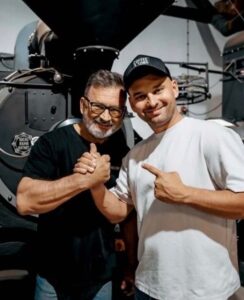
► MAREK ĆWIKŁA (left) is the head roaster at Coffee & Sons, a company founded by his son DANIEL (right). The name was intended to emphasise the family nature and multi-generational character of the business.
BUT WHAT KIND OF SYMBOLS AND VALUES are associated with craft coffee? And who benefits from them most of all? Dr Dominik Lewiński, a researcher and media expert at the University of Wroclaw, offers an explanation. In his view, drinking – and indeed the connoisseurship – of craft coffee fits into new trends of snobbery, serving as a way to affirm one’s middle-class status, where having selfless, expert hobbies is considered good form. It was similar with craft beer, to which craft coffee is compared by Magdalena Rzepka, Head of Marketing & Product at Coffeedesk and a sociologist by education.
‘By exploring the world of craft coffee, we feel somewhat closer to the product, especially since specialty coffee is the highest-quality, hand-picked coffee that is sold seasonally, so it’s never stored in warehouses. So by choosing such a product, we can feel that we’re doing something better for the planet and for ourselves,” she says.
These mechanisms were perfectly recognised by craft coffee producers – first foreign and then domestic ones who have adapted trends seen in more developed markets such as the Nordic countries, where drinking craft coffee is a long-standing tradition. Not without significance was and still is the influence of the United States – it was there that coffee roasted to order from local roasters entered the mainstream over a decade ago. However, the real turning point came during the lockdowns.
‘Until the COVID-19 pandemic, many Poles mainly enjoyed quality coffee out and about, in cafés or offices. The pandemic changed these habits almost overnight as people started to enjoy coffee at home, resulting in a sharp rise in sales of automatic coffee machines and whole bean coffee,’ says Ewelina Sas, marketing director at HAYB, a Polish coffee roaster founded after 2012 by the Borowski family which then recognised an untapped niche in the market dominated by corporations.
Sas also draws attention to an interesting phenomenon, namely that as a market, we have, in a sense, ‘skipped’ the phase of capsule dominance that was so evident in Western Europe.
Polish consumers have very smoothly transitioned from ground and instant coffee straight to freshly roasted beans. Today, more and more people are paying attention not only to the sensory profile, but also to the product’s origin, supply chain transparency and sustainable farming methods. ‘It is clear that our customers are more willing to choose beans from less well-known origins and are moving away from the rigid division between espresso and filter coffee,’ adds Ewelina Sas.
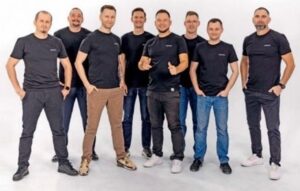
► HARD BEANS IS A COMPANY FROM OPOLE (pictured: its team) which started out with its own café and has since expanded into craft coffee roasting and developing coffee innovations.
► Polish consumers have smoothly transitioned from ground and instant coffee to freshly roasted beans
EWELINA SAS, marketing director at HAYB
REFINED PALATE AND KNOWLEDGE are just the beginning, as craft coffee requires the right equipment. Poles have therefore started looking for not only coffee machines and makers, but also grinders, scales, milk frothers and even matcha accessories. All of these items, not to mention the craft coffee itself and specialty coffee, are available from Coffeedesk, one of the largest online shops of this type in Poland.
In fact, it is difficult to tell the story of the Polish craft coffee market without mentioning this company, as the roastery owners I spoke to readily emphasised. In their view, no one has done as much for the Polish craft coffee market as Coffeedesk, first promoting coffee itself, and then the necessary brewing and drinking accessories. Magdalena Rzepka confirms that this was precisely the owners’ intention when they founded Coffeedesk in 2011, and since 2013, they have focused on specialty beans.
‘Coffeedesk has played a major role in educating consumers, showing them that coffee doesn’t always have to be dark-roasted for espresso, but can also be light-roasted, for example for filter brewing and pour-over methods” says Rzepka.
Today, Coffeedesk is the number one online retailer of specialty coffee in Poland, which is strongly present in the B2B sector, supplying cafés, restaurants and boutique hotels with professional equipment and products. The company also holds exclusive distribution rights for several international coffee brands, including La Marzocco, Bialetti, Aeropress and Fellow, and runs six cafés in Warsaw.
Artur Porada, CEO of Hard Beans – one of the three largest roasters in Poland – started out in the café business. In 2009, he returned to Poland from the Netherlands and used his savings to open a café in Opole. He was soon joined by Krzysztof Barabosz, who is now Head of Coffee and co-owner of Hard Beans. He is responsible for coffee supply and production. Over the following years, they worked together to educate their customers, running coffee workshops and setting up a barista league with which they travelled across Poland. They joke today that they are known as the dinosaurs of the Polish coffee market, as they were active when the market was still in its infancy. They currently focus on their coffee roastery, which has been operating since 2017 (and roasts around 10 tonnes of beans per month), as well as developing new technologies ‘in the service of coffee’.
They are the creators of the ‘hardtank’, a device for accelerated cold brew extraction, among other things. They also produce a range of canned coffee drinks, and they closed 2025 with a turnover of around PLN 16 million, compared to PLN 12.2 million the previous year. This year is to be even better, especially since, according to Krzysztof Barabosz, demand for craft and specialty coffee is being boosted by supply issues with mass-market coffee, the price of which has tripled over the last three years. Consequently, it happens that the price difference between coffee from a large producer and craft coffee is sometimes as little as PLN 10 per kilogram. Thus, bridging the price gap between the mass market and the craft market seems to be another growth opportunity for the latter.
HOWEVER, DANIEL ĆWIKŁA FROM COFFEE & SONS has no doubt that the entire Polish coffee market, not just the craft sector, still has its best years ahead of it.
‘When it comes to coffee consumption per capita, Poland is second from the bottom in Europe, with consumption at less than 3 kg per person per year. In Scandinavia, by comparison, it is 15 kg, so there is huge scope for growth for companies like ours. Especially as customers who have tried craft coffee mostly come back for more,’ he says.
However, this does not alter the fact that, as Sylwia Mokrysz emphasises, the craft coffee segment in Poland remains a niche market, albeit one that is growing faster than the coffee sector as a whole.
‘The coffee market is concentrated: global brands control over 60 per cent of the market share, but this nevertheless leaves sufficient room for growth only for smaller, domestic players, including craft roasters,’ says Sylwia Mokrysz.
How big is this room? Although research companies do not distinguish a separate category for craft coffee, the expert estimates that this segment, which is classified in the same group as specialty coffee, still accounts for less than 10 per cent of the market in Europe. However, it is growing rapidly.
‘Poland is still at an early stage. Currently, there are up to 300 roasters operating here, most of which are small family businesses that only roast coffee to order. Standards include transparency regarding the origin of the beans, small batches, seasonality and an emphasis on freshness. The most commonly offered origins are: Latin America (Colombia, Brazil and Guatemala), East Africa (Ethiopia and Kenya) and selected regions of Asia,’ the expert lists.
Specialty coffee accounts for an even smaller proportion of this market. Dawid Targosz-Zadara, Head of Coffee at the HAYB roastery, estimates that it accounts for less than 3 per cent of total coffee consumption in Poland. However, he views this positively: many people still have the opportunity to discover the flavour and, through it, the ‘beautiful stories of farmers from Guatemala, Colombia or Ethiopia’. And alongside the craft market, the market for coffee drinks is growing, which is not insignificant.
According to data provided by the XYZ portal, the value of the specialty coffee market in Poland in 2023 was approx. PLN 260 million, and it is estimated that it will grow by around 10 per cent annually over the next five years. The entire coffee market in Poland, meanwhile, is worth between PLN 7 and 8 billion. The largest part of this is the fresh coffee segment, comprising whole bean and ground coffee (the category in which craft roasters operate), which is estimated at around PLN 5.5 billion.
WHAT IS SPECIALTY COFFEE?
THE TERM WAS FIRST USED IN 1974 BY ERNA KNUTSEN to describe small batches of high-quality beans from unique microclimates. Knutsen noticed that coffee from specific regions, grown and processed with greater care, could surprise with a wealth of flavours. In practice, coffee that achieves a minimum of 80 points out of 100 in a professional cupping assessment is awarded the title ‘specialty’. This rating is awarded by certified sensory judges based on a standardised tasting protocol developed by the Specialty Coffee Association
(source: Blog Hard Beans)
SUMMARY
Poles have fallen in love with craft coffee, so we are exploring the origins of this phenomenon by speaking to the founders of Polish roasteries and coffee market experts.
Magdalena Gryn